Before You Automate: How to Find the Right AI Opportunities in Your Business
AI is everywhere. And for businesses, that creates an obvious question:
Where could we use it?
But that might be the wrong question to start with.
In a recent interview, Alex Hormozi shared the story of a company that had spent around $350,000 building an AI system to automate work being carried out by 11 virtual assistants, costing approximately $11,000 a month.
The technology worked. The problem was that automation wasn’t what the business actually needed.
According to Hormozi, the company needed more customers.
It’s an extreme example, but it highlights something we see increasingly as businesses explore AI: just because something can be automated doesn’t mean it should be your priority.
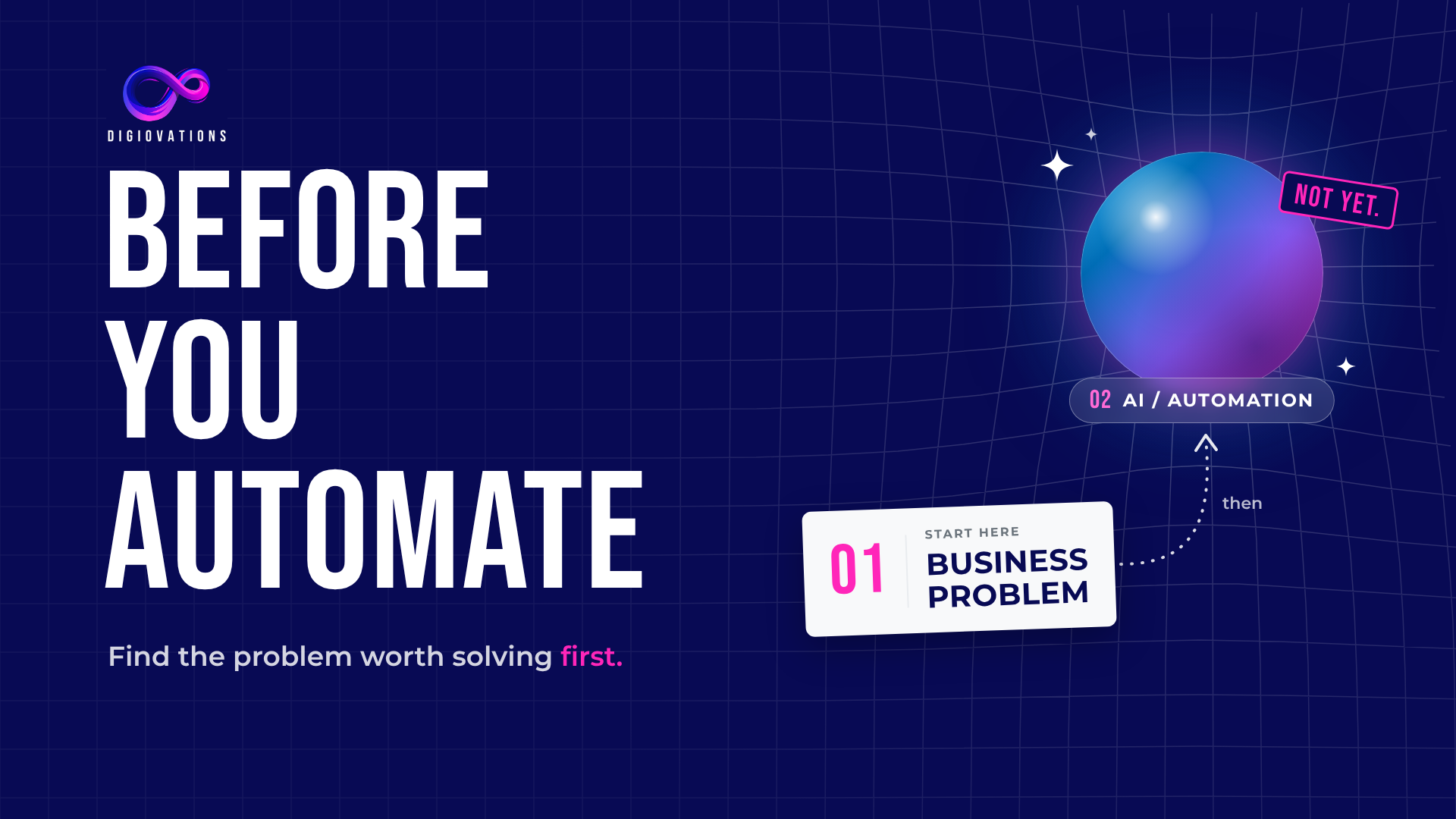
At Digiovations, we believe AI projects should start with the business problem, not the technology.
Here’s why.
The AI Automation Trap
The rapid development of generative AI, AI agents and automation tools has made it possible to automate tasks that would have been difficult or expensive just a few years ago.
That creates enormous opportunities for businesses.
It also makes it very easy to start in the wrong place.
A team spots a repetitive process. Someone sees an impressive AI demonstration. A new tool promises to save hours of work. Before long, the conversation becomes:
“Could we automate this with AI?”
Often, the answer is yes.
But there’s another question that matters much more:
Is this actually one of the most valuable problems for us to solve?
A business might successfully automate a process and save a few hours each week while a much larger bottleneck elsewhere continues to cost it customers, revenue or capacity.
The automation isn’t necessarily bad. It just wasn’t the best opportunity.
Just Because You Can Automate It, Should You?
Good automation isn’t about removing as many manual tasks as possible.
It’s about improving the right ones.
Before investing in AI or automation, businesses should understand what the existing problem is actually costing them and what would change if it disappeared.
That means looking beyond whether a task is technically automatable.
Time
How much employee time does the process actually consume?
A task taking ten minutes might be irritating, but if it only happens once a month, automating it probably isn’t going to transform the business.
The same task repeated hundreds of times each week is a very different proposition.
Cost
What does the current process cost, and how does that compare with the cost of changing it?
AI can reduce operational costs, but an expensive solution to a relatively inexpensive problem may struggle to justify itself.
Business Impact
What happens when the process is slow, inconsistent or unavailable?
Some processes directly affect customers, revenue or the organisation’s ability to grow. Others are simply inconvenient.
Understanding that difference is crucial when deciding what to prioritise.
Risk
Could mistakes create financial, regulatory, reputational or operational problems?
Processes involving sensitive data, important decisions or customer interactions may offer significant opportunities, but they may also require stronger governance and human oversight.
Feasibility
Finally, can the proposed solution realistically be delivered and adopted?
The most ambitious AI solution isn’t necessarily the best one. Sometimes a straightforward workflow, existing Microsoft 365 capability or small process change will deliver most of the value with far less complexity.
Start With the Business Problem
At Digiovations, our approach is simple:
Start with the business problem. Not the shiny technology.
Instead of beginning with “Where can we use AI?”, we encourage businesses to ask questions such as:
Where are our teams losing the most time? Which processes regularly create delays? Where are mistakes happening? What information is difficult for employees to find? Which activities stop us from scaling? Where are customers experiencing unnecessary friction? Which decisions take longer than they should? What work do skilled employees repeatedly do that adds little value?
Those questions reveal opportunities.
Only then should the conversation move to technology.
The right answer might be generative AI. It might be an AI agent. It could be Power Automate, Power Apps or another digital solution.
And sometimes the smartest AI recommendation is not to use AI at all.
What Does a Good AI Opportunity Look Like?
There is no universal checklist that makes a process suitable for AI, but there are some useful signals.
Repetitive Knowledge Work
Employees repeatedly reading, categorising, summarising or producing similar information can represent a strong opportunity for AI assistance.
Examples might include reviewing documents, drafting routine communications or extracting information from unstructured content.
Manual Processes at Scale
A small manual task can become a major operational burden when it happens hundreds or thousands of times.
Automation can reduce that workload and allow employees to focus on work where their judgement and expertise matter more.
Information Bottlenecks
Businesses often have the information employees need, but finding it is another matter.
Knowledge can be scattered across SharePoint, Teams, documents, emails and other systems. AI can potentially make that information easier to access and use.
Slow Decision-Making
Teams can spend significant amounts of time gathering information before they can make a decision.
AI can support people by bringing relevant information together, analysing it and helping them understand their options more quickly.
Importantly, decision support doesn’t have to mean handing the decision to AI. Human accountability can remain exactly where it belongs.
Processes That Limit Growth
Some problems become particularly valuable to solve because they prevent a business from scaling.
If increasing customer numbers means proportionally increasing administrative work, for example, automation may allow the organisation to grow without creating the same increase in overhead.
The common thread is not the technology.
It’s the business value created by solving the problem.
Prioritisation Matters
Most organisations don’t have one potential AI opportunity.
They have dozens.
That creates another challenge: deciding which ones deserve attention first.
A relatively simple automation with clear benefits might be a much better starting point than an ambitious AI agent requiring access to multiple systems, sensitive information and complex governance.
Equally, solving a strategically important problem may justify more investment than automating several smaller administrative tasks.
That is why opportunities need to be compared rather than assessed in isolation.
At a basic level, businesses should consider two things:
Value: How meaningful would the improvement be?
Feasibility: How realistic is it to deliver safely, affordably and successfully?
The strongest opportunities tend to perform well across both.
This helps businesses distinguish between something that makes an impressive AI demonstration and something worth investing in.
How Digiovations Identifies AI Opportunities
For organisations that know AI could help but aren’t sure where to begin, Digiovations takes an evidence-led approach.
We start by understanding how the organisation actually operates: its processes, frustrations, objectives and constraints.
From there, we identify areas where AI, automation or digital improvements could create genuine value.
Potential opportunities can then be assessed against factors such as business impact, feasibility, cost, risk and implementation complexity.
The result is a prioritised view of where it makes sense to act - and, just as importantly, where it doesn’t.
This is the thinking behind our AI Opportunity Report.
Rather than beginning with a predetermined technology, the goal is to understand the problems first and identify the simplest credible solutions to them.
Because a successful AI project isn’t one that uses the most impressive technology.
It’s one that solves a problem worth solving.
Frequently Asked Questions
Does every business need AI?
Not necessarily.
Most businesses are likely to find areas where AI can help, but that doesn’t mean every process needs it.
Existing software, traditional automation or a simple process change may sometimes solve the problem more effectively. The objective should be improving the business, not increasing the amount of AI it uses.
How do we know which processes are worth automating?
Start by looking at where time, money and opportunities are currently being lost.
High-volume repetitive work, persistent bottlenecks and processes that restrict growth are useful places to investigate.
From there, compare the potential value of solving each problem with the cost, complexity and risk involved.
What if we know AI could help but don’t know where to start?
That’s increasingly common.
The speed at which AI is developing means businesses can see the potential without necessarily knowing which use cases deserve investment.
Rather than selecting a tool and searching for somewhere to use it, start by examining the organisation itself. Understanding the problems first makes it much easier to identify where AI genuinely fits.
Should we automate an inefficient process?
Not automatically.
Automating a poor process can simply make the poor process run faster.
Before introducing AI or automation, it is worth asking whether the process itself should be simplified, redesigned or removed.
Find the Problem Before the Solution
AI is creating opportunities to rethink how organisations operate.
But access to powerful technology doesn’t remove the need for good business judgement.
The question isn’t how much AI you can introduce into your organisation.
It’s where AI - or another solution - can make a meaningful difference.
The company in Hormozi’s example didn’t necessarily have an automation problem. It had a prioritisation problem.
And as AI becomes easier to deploy, that distinction will become increasingly important.
At Digiovations, we help organisations identify and prioritise the opportunities where AI, automation and digital technology can create genuine business value.
Start with the business problem. Not the shiny technology.
If you know AI could help your organisation but aren’t sure where to begin, our AI Opportunity Report can help you identify what is worth pursuing - before you invest in building the wrong thing.